

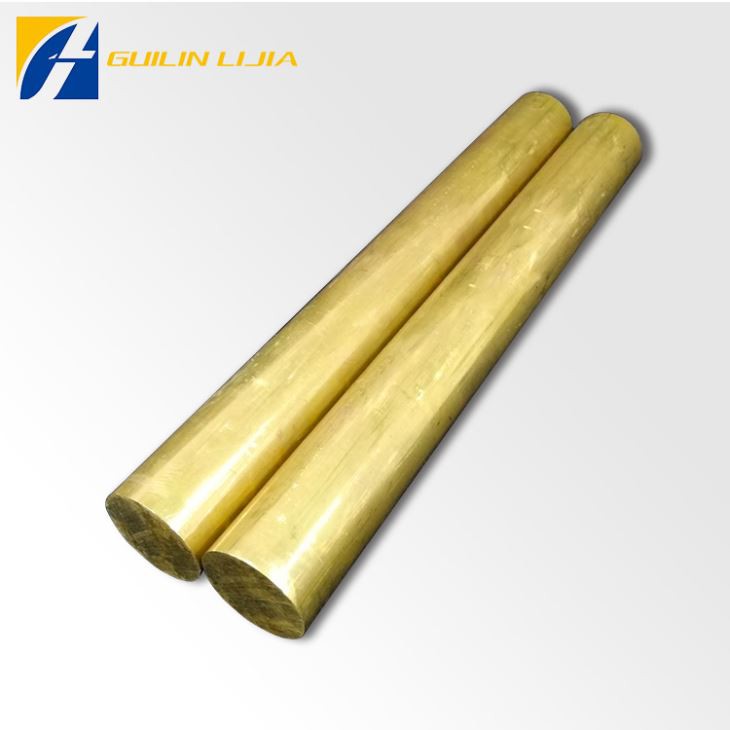
Brass Bar
Brass bars are the most widely used and least expensive copper-based alloys in existence. They have relatively good corrosion resistance, moderately high strength, and excellent ductility and forming characteristics in some compositions when shaped by pressing, deep drawing, rolling, and machining.
Why Choose Us?
Rich Experience
Guilin Lijia Metals Co., Ltd, established in 1976. Our company is a modern nonferrous-metals processing enterprise engaging in manufacturing copper and copper alloy (brass, copper-nickel and bronze) tubes/pipes/coils, rods/bars, profiles and finned tubes.
Professional Team
Our company has 10 functional management departments and 2 production workshops with 515 employees including 150 professional technicians and 30 technical engineers with middle and high rank titles.
Quality Control
We can meet different production specifications of copper and brass tube according to ASTM, EN, BS, DIN, JIS and so on.
Advanced Equipment
Guilin Lijia has 130 sets processing and testing equipments, mainly are followings: mainly are followings,22MN water-seal extruding machine introduced from Japan, Roller bright annealing furnace introduced from Germany, Coils drawing machine introduced from Britain, Casting furnaces, Rolling machines and drawing machines, Spectrum analyzer introduced from Switzerland.


Composition of Brass Bar
Round brass materials are long, circular products that have a circular cross-section. This semi-finished object is made of cast or kneading brass. Cast brass is great for casting. Forming is a good use for kneading brass (forging, rolling, and bending). There are three types of brass rods: soft, semi-hard, and firm. It can be between 4 and 200 millimeters in diameter.
Brass is an alloy that contains 50% of copper and 40% of zinc in it. Other metals like silicon, lead, iron, manganese, nickel, and aluminum can be present in trace amounts of this alloy.
This substance is composed of approximately 57-59 percent copper, 36-40 percent zinc, and 2.5-3.5 percent lead. There is little to understand about this alloy, and it can be machined on an automatic machine. In addition, it is the most common alloy for machining. The grade is not recommended for welding due to the lead concentration. Water, salt solutions, and organic liquids are particularly susceptible to corrosion of it due to their low corrosion resistance.

ABrass bar has several physical and chemical properties that make it a popular choice for various applications. Some of these properties include:
● Melting point: Brass bar has a relatively low melting point, typically between 900°C and 940°C, making it easy to work with.
● Thermal conductivity: Brass bar has a high thermal conductivity, meaning it can transfer heat quickly and efficiently.
● Electrical conductivity: Brass bar is also an excellent conductor of electricity, making it suitable for use in electrical components.
● Hardness: Brass bar is a relatively soft metal, making it easy to shape and form.
● Corrosion resistance: Brass bar has excellent corrosion resistance, particularly when compared to other metals such as iron or steel.
● Machinability: Brass bar is easy to machine and can be shaped into various forms, making it a popular choice for manufacturing.
Brass Bar: A Champion of Recycling
One of the most compelling benefits of brass bar is its ability to be recycled an infinite number of times without any loss of chemical or physical properties – when re-melted and formed back into its raw state, it retains the exact same properties as the starting material. Brass is one of the most recycled metals globally. In fact, many brass product lines feature over 95% recycled content.
Recycling brass significantly reduces the need for virgin materials (copper and zinc), lessens environmental impact, and keeps waste out of landfills. It's a vital component of the circular economy, where resources are reused rather than discarded after single use.
The production economics of brass bar are built upon a "closed loop" recycling process. In this system, brass scrap generated during subtractive manufacturing processes (e.G., machining and forging to produce finished parts) is returned back to the producing rod mills where it is directly remelted, cast, and extruded back into new brass bar products.
This strict separation ensures the quality and reusability of the recycled brass, cycle after cycle. Collaborative efforts among rod mills, machine shops, and scrap yards to keep different alloy streams separate is essential to ensure the long-term viability of brass recycling.
Benefits of Brass Bar
Brass is an alloy of copper, zinc, and other metals, contributing to its strength, workability, and aesthetic appeal. This metal offers a wide range of advantages as a brass bar.
Superior ductility
Brass is a highly malleable metal, giving you peak flexibility in designing the shape and form of your project. Brass bars offer superior ductility, allowing it to flex and bend without breaking. This flexibility makes brass bars perfect for intricate parts and components that require precise fabrication.
Easy to manipulate
Brass bar provides excellent machinability, which makes it easy to shape and manipulate. Whether you need to drill, mill, roll, press, bend, or cut your flat bar, it will offer superior performance and optimal results. This is especially useful for projects requiring complex and intricate designs.
Corrosion-resistant
Brass bars offer outstanding corrosion resistance, making them ideal for outdoor projects and applications. The chemical structure of brass resists rust, corrosion, and other forms of degradation, making the material last longer and ensuring peak performance. Brass bars will maintain their integrity in harsh environments without requiring extra protective coating or treatments!
High tensile strength
Brass bars provide superior tensile strength, ensuring your project performs optimally. Their high strength-to-weight ratio makes them perfect for lightweight yet sturdy
Components. Brass bars are especially useful in construction projects that require solid and resilient parts without adding extra weight.
Electrically conductive
Brass is a highly conductive metal, making it the perfect choice for electrical projects. With their superior electrical conductivity, brass bars will help you achieve the desired results in your wiring and electrical applications. This versatile metal also has non-sparking qualities, making it perfect for hazardous environments.
Aesthetic appeal
As a bonus, brass bars also provide a stunning and unique aesthetic with their rich color and smooth finish. This highly reflective metal makes it excellent for projects requiring a polished look or extra shimmer. You can enjoy the attractive golden-hued sheen of brass flat bars without sacrificing performance or quality.
Types of Brass Bars
Brass round bars
Brass round bars range in diameter from 3/32 to 6 inches. Standard lengths are up to 12 feet, and custom lengths are available to meet your needs. Round bars are commonly used for tooling, base plates, decorative objects, and electrical applications.
01
Brass hexagon bars
Brass hexagon bars in diameters from ¼ to 2½ inches. Hexagon brass bars may be purchased in standard lengths from under one foot to 12 feet as well as custom lengths. Hexagonal bars can be used for many of the same applications as round bars, in addition to houseware and braces.
02
Brass rectangle bars
Ranging in size from 1/8 x 1/4 inches to 2 x 4 inches, brass rectangular bars are available up to 12 feet long, with custom lengths to suit your requirements. Rectangular brass bars are suitable for marine hardware, instruments, fittings, and fasteners.
03
Brass square bars
Brass square bars are made in sizes from 1/4 to 3 inches and lengths from under a foot to 12 feet. Square brass bars are ideal for most of the same applications as rectangular bars.
04
Connectors, machined components, marine shafts, and propellers are just some examples of the typical applications for brass round rods and bars. The remarkable resistance of the alloy to corrosion brought on by exposure to salt water makes the brass bar a popular choice for use in a wide variety of marine applications.
As a result of the qualities of the alloy, round bars made of brass are utilised in a wide variety of industrial settings. Round rods and bars have a wide variety of applications, including those requiring high pressure, companies involved in the production of paper, water mains, nuclear power plants, food processing, and the production of products like milk, as well as boilers.
As a result of the qualities of the alloy, round bars made of brass are utilised in a wide variety of industrial settings. Brass extrusion rods and brass round bars have a wide variety of applications, including those requiring high pressure, companies involved in the production of paper, water mains, nuclear power plants, food processing, and the production of products like milk, and boilers. In addition to their use in the oil and gas industry, round bars find use in pipelines, chemical refineries, high-temperature applications, and heating components, among other places.
Brass Bar Grades
C26000 (Cartridge Brass): Averaging 30% zinc and 70% copper, cartridge brass is one of the most economical brass alloys offering a balanced combination of strength, ductility, and corrosion resistance.
C26800 (Sheet and Coil): Around 66% copper, yellow brass is conducive to cold working, soldering, and brazing.
C27200 (Brass Tubes): With 62-65% copper, this alloy is strong, durable, and easily worked. This is usually used for brass tubing.
C33000 (Low-Leaded Brass): With about 65-68% copper, low-leaded brass is easy to machine and bend.
C36000 (Free-Cutting Brass): Averaging 61.5% copper and close to 3% lead, free-cutting brass is easier to work and cut. 360 brass is commonly used for brass bars.
C38500 (Architectural Bronze): Consisting of about 57% copper and 2.5-3.5% lead, this alloy is particularly durable and corrosion-resistant. Unlike other brass alloys, architectural bronze can be hot formed.
C46400 (Naval Brass): The most corrosion-resistant of popular brass alloys, naval brass averages 60.5% copper and up to 1% tin, making it suitable for saltwater exposure.
Our Factory
Guilin Lijia Metals Co., Ltd, established in 1976, is a key enterprise of copper fabrication in Guangxi, China. Our enterprise, as a key exporting enterprise in Guangxi, is the council member of China Nonferrous Metals Association. We are located in Tieshan Industrial Park of Guilin High and New Technology Industrial Development District.
Our company is a modern nonferrous-metals processing enterprise engaging in manufacturing copper and copper alloy (brass, copper-nickel and bronze) tubes/pipes/coils, rods/bars, profiles and finned tubes. Persevering in development orientation of "special, innovation, shaped and preciseness", we have accumulated more than 40 years' manufacturing experience and held yearly capability of 16,000 tons.
Insisting on global business strategy and worldwide marketing net, we started exporting business since 1998 and have steady market in USA, Europe, Australia, Canada and Southeast Asia.
Our corporate culture slogans are "teamwork, perseverance, preciseness, sincerity and innovation".
Registered capital of Guilin Lijia reaches 187 million. Our shareholders include Guangxi Hanggui Industrial Co., Ltd (52.52%), China Orient Assets Management Co., Ltd (34%) and Guilin National Asset Investment Management Company (13.48%).

Our certificate
Guilin Lijia has a professional management system, which is certified by ISO 9001: 2015, ISO 14001: 2015 and OHSAS 18001: 2007.
Our quality assurance system is certified by TUV SUD Industrie Service GmbH in accordance with the Pressure Equipment Directive 2014/68/EU, Annex I, Section 4.3, AD 2000-Merkblatt W 0 as well as EN764-5, Para. 4.2.
Besides, we also get Certificate of Works Approval authorized by China Classification Society.
Our Intellectual Property Management System is in accordance with GB/T 29490-2013.

FAQ
Q: What is brass bar?
Q: What are the uses of brass bar?
Q: Can brass bars be recycled
Q: Is brass bar better than steel rod?
Q: Is a brass bar strong?
Q: Can you weld brass bars?
Q: Are brass bars magnetic?
Q: What are the chemical properties of brass bars?
● Melting point: Brass bar has a relatively low melting point, typically between 900°C and 940°C, making it easy to work with.
● Thermal conductivity: Brass bar has a high thermal conductivity, meaning it can transfer heat quickly and efficiently.
● Electrical conductivity: Brass bar is also an excellent conductor of electricity, making it suitable for use in electrical components.
● Hardness: Brass bar is a relatively soft metal, making it easy to shape and form.
● Corrosion resistance: Brass bar has excellent corrosion resistance, particularly when compared to other metals such as iron or steel.
● Machinability: Brass bar is easy to machine and can be shaped into various forms, making it a popular choice for manufacturing.
Q: What is the melting point of brass bar?
Q: Why choose brass bar?
Recycling brass significantly reduces the need for virgin materials (copper and zinc), lessens environmental impact, and keeps waste out of landfills. It's a vital component of the circular economy, where resources are reused rather than discarded after single use.
Q: What is a brass bar made of?
Q: What are the mechanical properties of brass bars?
Q: Can brass bar be soldered?
Q: What is the grade of brass bar?
Q: What is the ASTM standard for brass bar?
Q: What is the most common grade of brass bar in the industry?
Q: What are the advantages of brass bars?
1. Superior ductility
Brass is a highly malleable metal, giving you peak flexibility in designing the shape and form of your project. Brass bars offer superior ductility, allowing it to flex and bend without breaking. This flexibility makes brass bars perfect for intricate parts and components that require precise fabrication.
2. Easy to manipulate
Brass bar provides excellent machinability, which makes it easy to shape and manipulate. Whether you need to drill, mill, roll, press, bend, or cut your flat bar, it will offer superior performance and optimal results. This is especially useful for projects requiring complex and intricate designs.
3. Corrosion-resistant
Brass bars offer outstanding corrosion resistance, making them ideal for outdoor projects and applications. The chemical structure of brass resists rust, corrosion, and other forms of degradation, making the material last longer and ensuring peak performance. Brass bars will maintain their integrity in harsh environments without requiring extra protective coating or treatments!
4. High tensile strength
Brass bars provide superior tensile strength, ensuring your project performs optimally. Their high strength-to-weight ratio makes them perfect for lightweight yet sturdy
Components. Brass bars are especially useful in construction projects that require solid and resilient parts without adding extra weight.
Q: What is the ductility of brass bars?
Q: Is the brass bar corrosion-resistant?
Q: Is the tensile strength of brass bar high?
Components. Brass bars are especially useful in construction projects that require solid and resilient parts without adding extra weight.
As one of the most professional brass bar manufacturers and suppliers in China, we're featured by quality products and competitive price. Please rest assured to wholesale brass bar for sale here from our factory. Contact us for custom service.
copper fittings bar and rod, brass fitting rod and bar, Brass Bar For Fittings