

Brass Profiles
Why Choose Us
Advanced Equipment:
Testing equipments, mainly are followings,22MN water-seal extruding machine introduced from Japan;Roller bright annealing furnace introduced from Germany;Coils drawing machine introduced from Britain;Casting furnaces;Rolling machines and drawing machines;Spectrum analyzer introduced from Switzerland.
Rich Experience:
Persevering in development orientation of"special, innovation, shaped and preciseness", we have accumulated more than 40 years'manufacturing experience and held yearly capability of 16,000 tons.
One-stop servic:
From the begining inquiry and throughout the entire process until you receive the goods. we are dedicated to supporting you every step of the way.
Our certificate:
Guilin lijia has a professional management system, which is certified by iso 9001: 2015, iso 14001: 2015 and ohsas 18001: 2007.
Brass profiles are paired with many flooring types, including carpets, tiles and laminates. These profiles are long-lasting, suitable for heavy pedes- trian traffic areas and are often speci- fied for their favourable aesthetics. Brass profiles can be specified in their natural. state or with a polished finish.


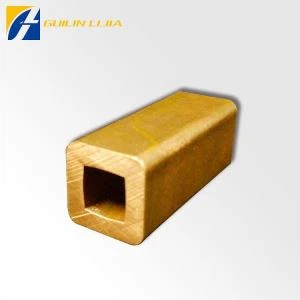


Benefits of Brass Profiles
Corrosion resistance:
Rass is more resistant to corrosion compared to copper, making it suitable for use in marine environments and for plumbing applications.
Malleability and ductility:
Brass is more malleable and ductile than copper, allowing it to be easily shaped and formed into various products and components.
Higher melting point:
Brass has a higher melting point than copper, making it more suitable for applications that involve high temperatures, such as in casting and machining processes.
Cost-effectiveness:
Depending on market conditions, brass can sometimes be more cost-effective than pure copper,making it an attractive alternative for certain applications.
What are the Applications of Brass Profiles
Electronics and telecommunications: Brass is used for electronic parts that require conductivity and corrosion resistance,like plugs,jacks,switches,condensers,printed circuit boards,and shielding. the ability to alloy brass provides specific properties for electronic applications.
Transportation equipment: Brass is used throughout transportation for corrosion-resistant,attractive parts.uses include door handles,trim,radiator parts, fasteners,instruments,and hardware in automobiles,trains,and aircraft.naval brass withstands saltwater for marine propellers,pumps,and valves.
Ammunition and cartridges: Cartridge brass, an alloy suited for deep drawing,makes cartridges and bullet casings. the brass must withstand high pressures,temperatures, and physical stresses from firing and loading ammunition.
Musical instruments: The acoustic properties of brass alloys and their castability into precision bells and tubes have made them suitable for crafting musical instruments like trumpets,trombones,tubas,french horns, saxophones,bugles,etc.the brass parts help produce and amplify musical tones.
Types of Brass Profiles

01
Alpha Brasses:
Alpha brasses contain 67-72% copper and 28-33% zinc. they are malleable and utilized in pressing,forging,and other related applications. in addition, they can be worked cold

02
Alpha-beta brasses:
Alpha-beta brasses contain 55–65% copper and 35–45% zinc. these brasses, also known as duplex brasses,are suitable for hot working.

03
Beta brasses:
Beta brasses contain 50–55% copper and 45–50% zinc. these brasses can only be worked hot. they are harder,stronger,and appropriate for casting.

04
Gamma brasses:
Gamma brasses contain 33-39% copper and 61-67% zinc. there are also ag-zn and au-zn gamma brasses,with ag 30-50% and au 41%,respectively. the gamma phase is an intermetallic compound with a cubic lattice structure, cu5zn8. gamma brasses are typically used for specialized applications,including high-strength electrical contacts and fasteners.

The primary components of brass are copper and zinc.the ratio of these two metals can vary,resulting in different types of brass with unique properties. the composition of brass is generally 66% copper and 34% zinc. however,by weight,brass contains between 55% to 95% copper and 5% to 45% zinc. elements such as lead,tin,or aluminum can also be added to brass to enhance specific characteristics.lead promotes corrosion resistance and machinability,whereas iron increases hardness and facilitates alloy forging easier.
Process of Brass Profiles
Step 1. Mining and processing copper ore into copper metal which is almost 100%, pure copper. Zinc ore is also processed into nearly pure zinc metal.
Step 2. The purified copper and zinc metals are heated to melting points of 1083°C and 419 in a furnace according to the desired brass composition.
Step 3. The molten metals are mixed thoroughly to form brass according to predetermined percentages of copper and zinc.Impurities and bubbles are removed.
Step 4. The molten brass is poured into molds to cast it into bars, ingots, or other shapes; or extruded through dies to form tubes, rods,or plates.
Step 5. The cast or extruded brass is often treated using techniques like annealing, cold working,grinding, or polishing to improve properties,strength,hardness,surface finish,machinability,or corrosion resistance.
Step 6. Additives like lead,tin,aluminum,or manganese are sometimes included in the composition to produce brass alloys with specific properties depending on the intended application.
Step 7. Once cooled and treated,the brass product is finished and ready to be fabricated or used for its intended purpose.Final inspections verify that it meets the required standards.
Properties of Brass Profiles
Corrosion Resistance:
Brass is resistant to tarnishing and corrosion,making it suitable for outdoor and marine environments.
01
Malleability:
Brass is easily shaped and formed,allowing for intricate designs and easy fabrication.
02
Low Friction:
Brass exhibits low friction,making it ideal for applications requiring smooth movement,such as gears and bearings.
03
Acoustic Properties:
Brass has excellent acoustic properties,making it a popular choice for musical instruments like trumpets and saxophones.
04
Aesthetics:
Brass has a warm,gold-like appearance that can be polished to a high shine or given a more aged,patina finish.
05
Product maintenance and precautions

How To Maintain Brass Profiles
Soapy water cleans gently
Flour, vinegar and salt: A recipe for brass cleaning
Citric acid: From matte to shiny
Tomato sauce: Makes stains disappear
Guilin Lijia has a professional management system, which is certified by ISO 9001: 2015, ISO 14001: 2015 and OHSAS 18001: 2007.

Guilin lijia metals co., ltd, established in 1976, is a key enterprise of copper fabrication in guangxi, china. our enterprise, as a key exporting enterprise in guangxi, is the council member of china nonferrous metals association. we are located in tieshan industrial park of guilin high and new technology industrial development district.


FAQ
Q: Does brass need maintenance?
Q: How do you make brass look good again?
Q: What is the best coating for brass?
Q: What makes brass shiny again?
Q: What is the description of brass?
Q: Is all brass the same?
Q: Is brass a metal or metal?
Q: Is brass a quality metal?
Q: 9.What type of brass is best?
Q: How do you know if something is 100% brass?
Q: Is brass better than gold?
Q: Why is brass so expensive?
Q: Can brass rust?
Q: Is brass a cheap metal?
Q: Why do luxury brands use brass?
Q: Is brass better than stainless steel?
Q: 17.Is brass stronger than steel?
Q: How do I clean brass?
Q: What are the advantages of brass?
Q: Does 100% brass turn green?
As one of the most professional brass profiles manufacturers and suppliers in China, we're featured by quality products and competitive price. Please rest assured to wholesale brass profiles for sale here from our factory. Contact us for custom service.
Antique Brass Tube Handrail, Decorative Reeded Brass Tubing, Hexagon Tube